
When
Thursday 24th Sep 2026 @ 6:30 pm –
Thursday 24th Sep 2026 @ 7:30 pm
Where
Online (Zoom)
What can (and cannot) science tell humans about ourselves and the world?
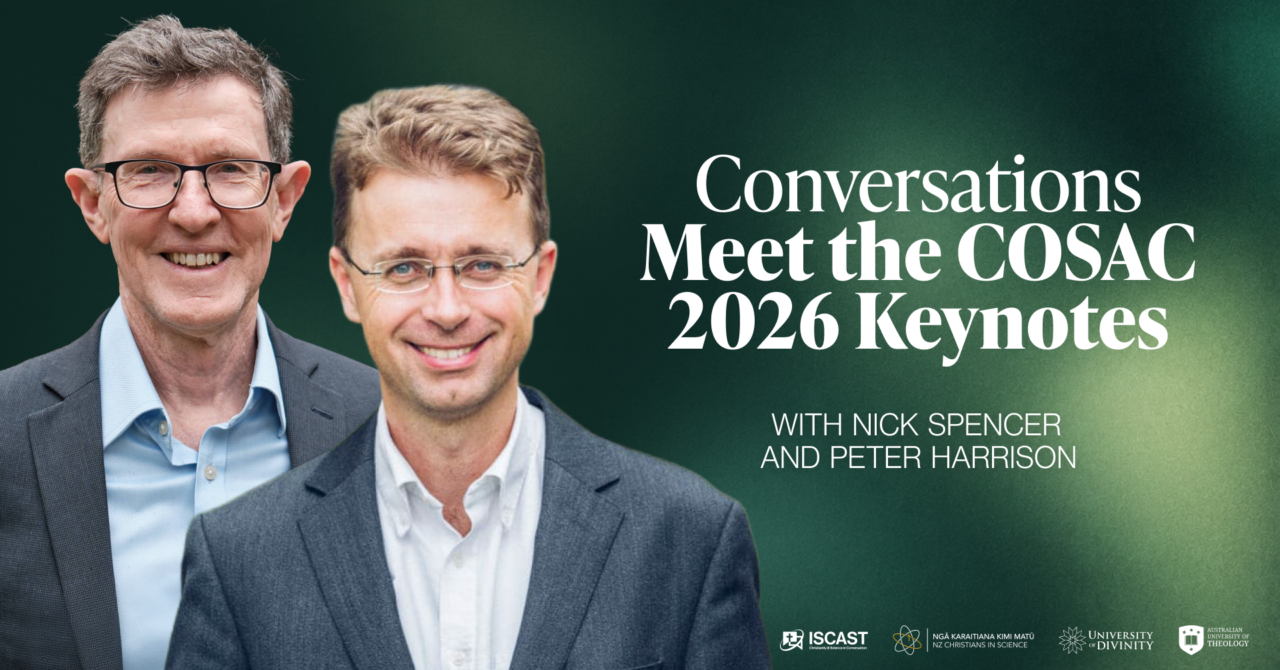
Ahead of ISCAST’s 15th biennial Conference on Science and Christianity, the conference’s keynote speakers will meet online for free previews of their talks. In this second session, Peter Harrison will assess whether a comprehensive understanding of the world from a faith perspective necessarily incorporates the findings of the natural sciences or not. Nick Spencer will argue that science and religion have got on better than many people think, but they have fallen out when one or the other has claimed comprehensive and definitive knowledge of human beings. Afterwards, they’ll take audience questions.
Details
This Conversations series is free to attend. Please register to receive the Zoom link, as well as an email reminder.
- Date: Thursday 24 September 2026
- Time: 6:30–7:30 p.m. AEST / 8:30–9:30 p.m. NZST
- Location: Online (Zoom)
The Conversations are organised in collaboration with New Zealand Christians in Science.
Topics
Entangled humans: what science can (and cannot) tell us about ourselves
Nick Spencer
Abstract
Throughout history, some of the most interesting, and lively, encounters between “science” and “religion” have been over the nature and status of the human. The unprecedented success of natural philosophy in working out how the material world works naturally encouraged natural philosophers, and their “scientific” successors, to apply the same techniques to human beings. But the scientific record here been less than wholly successful. This lecture will look at some of the examples of such encounters, before exploring why, in principle, this is a doomed endeavour, and why, in an age of AI and genetic engineering, this failure matters more than ever.
Bio
Nick is Senior Fellow at Theos. He is the author of a number of books and reports, most recently, ‘The Landscapes of Science and Religion’ (OUP, 2025), ‘Playing God: Science, Religion and the Future of Humanity’ (2024), and ‘Magisteria: the entangled histories of science and religion’ (Oneworld, 2023). His next book, on ‘Christianity and the Future of Welfare’ is due out with Cambridge University Press in 2026. Nick is host of the Theos podcast Reading Our Times, and outside Theos he is Honorary Professor at the World Religions and Education Research Unit, Bishop Grosseteste University; Visiting Research Fellow at St John’s College, Durham; Visiting Fellow at the Faiths and Civil Society Unit, Goldsmiths, University College, London; and Fellow of the International Society of Science and Religion. He tweets infrequently @theosnick.
Seeking Understanding through Faith—and Science?
Peter Harrison
Abstract
The nineteenth-century German philosopher Wilhelm Dilthey made a celebrated distinction between explanation and understanding. This, he believed, characterised the difference between the natural sciences, which seek explanations, and the humanities, which seek understanding. If Dilthey is correct it would seem that the natural sciences do not directly enhance our understanding of the world, but rather enable us to better predict its operations and manipulate it. Drawing on a range of examples from the history of science, I assess the validity of Dilthey’s distinction and consider its possible application to fundamental differences between faith and science. At stake is whether a comprehensive understanding of the world from a faith perspective necessarily incorporates the findings of the natural sciences or not.
Bio
Peter Harrison is a Professorial Research Fellow at the University of Notre Dame, Australia, and Emeritus Professor of History and Philosophy at the University of Queensland. He was previously the Idreos Professor of Science and Religion at the University of Oxford and subsequently an Australian Laureate Fellow and Director of the Institute for Advanced Studies in the Humanities at the University of Queensland. His most recent book is Some New World: Myths of Supernatural Belief in a Secular Age (Cambridge, 2024).