
This event has passed
When
Thursday 17th Sep 2026 @ 6:30 pm –
Thursday 17th Sep 2026 @ 7:30 pm
Where
Online (Zoom)
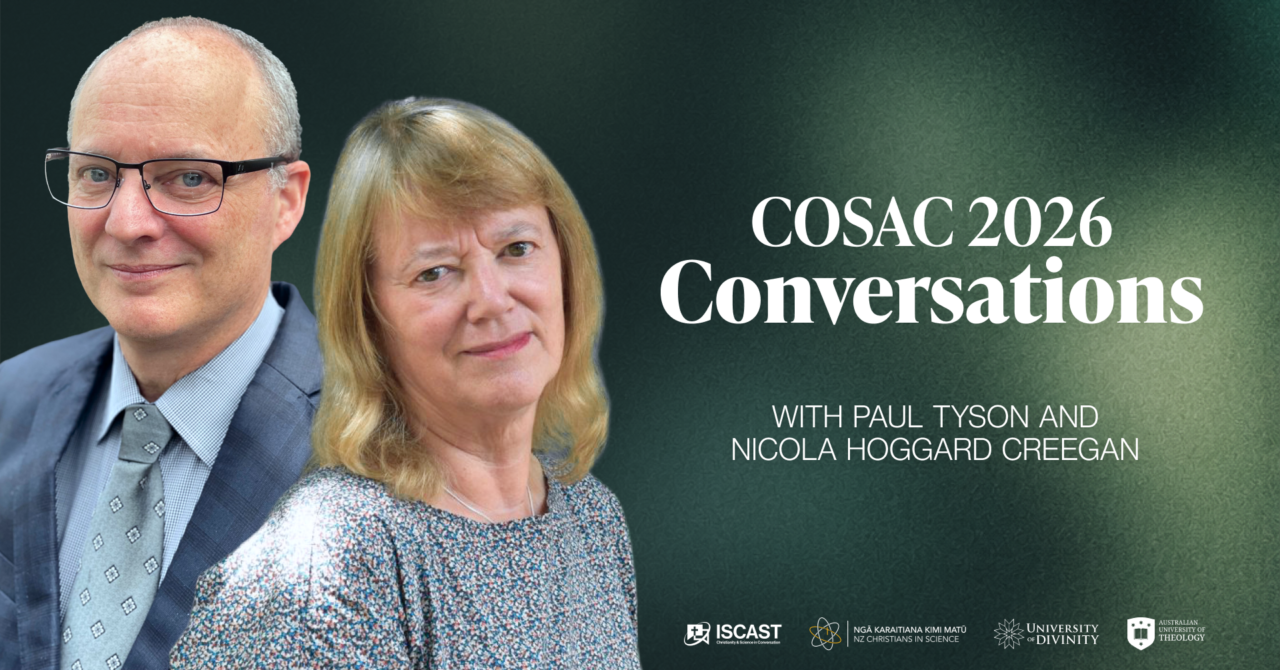
Ahead of ISCAST’s 15th biennial Conference on Science and Christianity, the conference’s keynote speakers will meet online for previews of their talks. In the first session, Nicola Hoggard Creegan will explore how Mātauranga Māori’s introduction into Aotearoa’s science curriculum may disrupt science more thoroughly than theology ever has. Paul Tyson will make the case that the conflict between religion and the sciences was manufactured in the late nineteenth century, and that it worked. Afterwards, they’ll take audience questions.
Details
This Conversations series is free to attend. Please register to receive the Zoom link for both sessions, as well as email reminders for each.
- Date: Thursday 17 September 2026
- Time: 6:30–7:30 p.m. AEST / 8:30–9:30 p.m. NZST
- Location: Online (Zoom)
The second session will follow on 24 September and will feature Nick Spencer and Peter Harrison. The Conversations are organised in collaboration with New Zealand Christians in Science.
Topics
Science, theology and the disruption of Mātauranga Māori in Aotearoa
Nicola Hoggard Creegan
Abstract
Although the science and theology literature has burgeoned in the last three decades, the two knowledge systems remain at a relative standoff at the practical and institutional level: churches rarely treat the sciences as central to virtue, and a source of knowledge about God, and science departments resist theological insight, fearing it compromises the purity of the scientific method. Both knowledge systems are creative engagements with reality, “meeting the universe half-way”, yet each still in some way defines itself against the other. Why, after so long, does the specialist conversation stay so distinct from the everyday practice of both faith and science? Do arguments about possible compatibility not touch a deep intuitive incompatibility? Is Deism still lurking in the theological and scientific shallows? I examine these tensions and consider how Mātauranga Māori’s introduction into Aotearoa’s science curriculum may disrupt science more thoroughly than theology ever has, opening its practice to other levels of explanation and closure.
Bio
Nicola is a theologian and Director of New Zealand Christians in Science, based at Maclaurin Chapel at the University of Auckland. She specialises in the interface between evolutionary theory and systematic theology, with broad interests in all issues of public and contextual theology and ecology. She is the author of Animal Suffering and the Problem of Evil (OUP, 2013) and co-edited Creation and Hope (Wipf & Stock, 2018). She was a part of the Human Nature Project at CTI in Princeton, 2012-2013, and the Human Distinctiveness Project at Notre Dame 2015-2016. Nicola has taught theology in the US and NZ. Her doctorate is in theology, but her original training was in mathematics and biology. She is the current Chair of A Rocha Aotearoa New Zealand, a Christian environmental NGO.
No Conflict? Thomas Huxley’s scientific naturalism and the de-Christianisation of the West.
Paul Tyson
Abstract
Because facts and meanings, understanding and interpretation, ontology and epistemology, and faith and reason are inextricably entangled, the late-Victorian invention of a strict demarcation between scientific facts and religious beliefs is fraudulent. Equally, the war of science against religion that Thomas Huxley so effectively launched to de-legitimise Christian authority in Western knowledge and norms, is also fraudulent. Yet it was profoundly successful. If Christians are to recognise the unavoidable entanglement of immanence with transcendence, then they must recognise that Huxley and company not only advanced a virulent conflict thesis of secular public knowledge against the authority of Christianity in the West, but by the late twentieth century the de-Christianising of the West had been achieved, in the name of science. This talk argues that it is time Christians stopped pretending that they did not lose Huxley’s war and embraced vigorous conflict with Huxleyite scientific naturalism.
Bio
Dr Paul Tyson has sole authored nine books in Christian metaphysics, Kierkegaard and Plato scholarship, science and religion, and philosophical critiques of gender theory. He coordinated the Templeton Foundation–funded After Science and Religion Project with Professor Peter Harrison. The project resulted in four edited collections as well as Paul’s monograph, A Christian Theology of Science: Re-Imagining a Theological Vision of Natural Knowledge (Baker Academic, 2022). Paul is now retired.