
This event has passed
When
Thursday 7th May 2026 @ 6:30 pm –
Thursday 21st May 2026 @ 6:30 pm
Where
Online (Zoom)
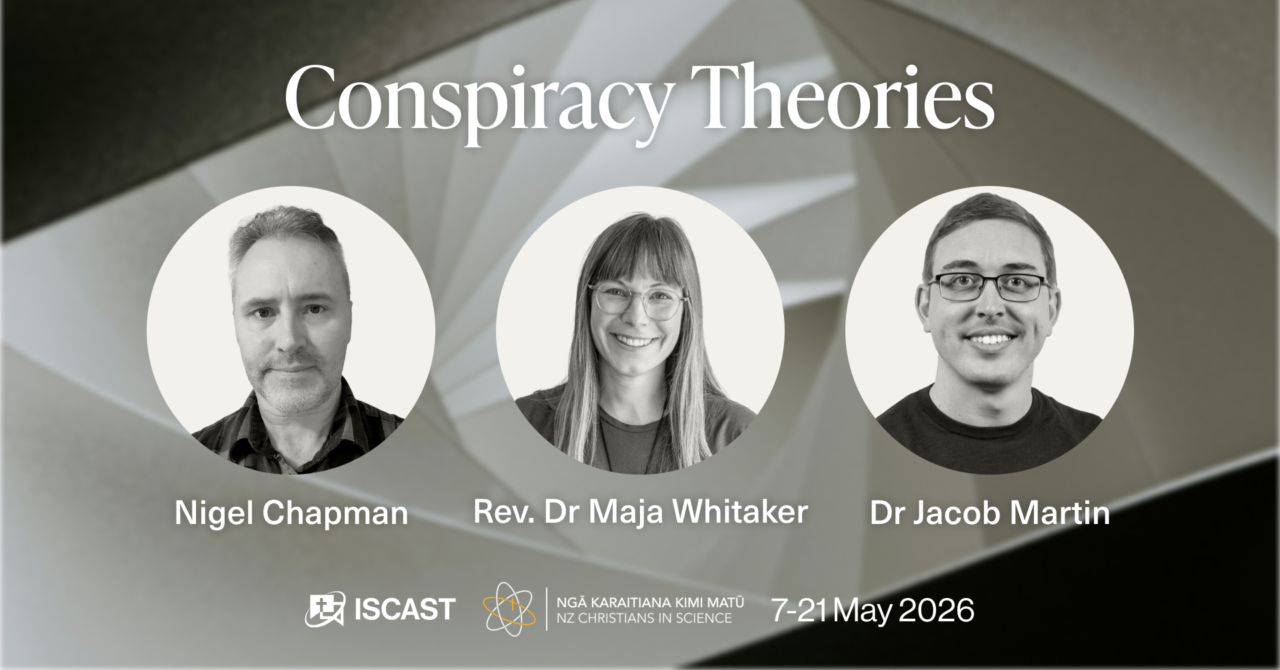
Conspiracy theories are everywhere, and Christians are not immune. In this three-part series, the ISCAST–NZCIS Conversations 2026 brings together scholars from across science, theology, and technology to explore why conspiracy theories spread, who believes them, and what resources Christian faith offers for navigating a world awash with misinformation.
Details
- Thursday nights, 7, 14, and 21 May on Zoom
- 6:30–7:30 p.m. AEST / 8:30–9:30 p.m. NZST
Registration
For this Conversations series, one ticket gives you access to all three sessions.
- $40 for non-members
- $30 for ISCAST/NZCIS members
- Free for students
Not yet a member? Join ISCAST or NZCIS today.
Registered participants will also receive early access to recordings of each session.
Conversations

The ‘So-Called Experts’ in Christianity and Conspiracism
7 May — Nigel Chapman
Our understanding of expertise affects how we think about conspiracy theories. Conspiracism says that we can’t trust our “mainstream” institutions of knowledge, or “the so-called experts.” It says they have biases and vested interests, and also contradict each other. This mindset partly overlaps with older Christian mistrust of expert knowledge, which has focused on human nature, human origins, and biblical inspiration.
In our present “culture war”, institutions of expert knowledge are coded leftist, globalist, elitist, secular, and “woke”—or captured by such interests—and so are seen by many Christians as an enemy. So how should we understand expertise? When does an idea become expert knowledge? How does it regulate and correct itself? How much can ordinary Christians trust it? And what is our role as Christians who have more expert knowledge than most, especially of science, medicine, and theology?
Bio
Nigel Chapman studied Computer Science at UNSW and Divinity at Morling. By day he negotiates with the computers on behalf of the humans. He was co-convenor, editor, and lead author for the ISCAST lockdown project Who to Trust? Christian Belief in Conspiracy Theories (2022), which aimed to survey and summarise recent research on conspiracism, and to which a dozen highly qualified ISCAST members contributed their time. He lives in Melbourne and puzzles things out at chapman.wiki.

The Psychological Appeal of Conspiracy Thinking
14 May — Maja Whitaker
Why do conspiracy theories appeal to so many people? This talk will explore the psychological pull of conspiracy theorism and consider how it addresses fundamental human needs, provides compelling narratives, and fosters powerful social networks.
Bio
Rev. Dr Maja Whitaker is academic dean and lecturer in Practical Theology at Laidlaw College in New Zealand, based at the Christchurch campus. She comes to theology from a background in anatomical science and bioethics, and is an ordained pastor in the ACTS movement.

That’s a Good Question: Addressing Doubts in Science Through Historical Narratives
21 May — Jacob Martin
Online interactions often cause people to remain in doubt rather than move toward certainty. Scepticism and doubts are key to the scientific method and a healthy part of religious faith but have recently been used to undermine the idea of truth and trap us within uncertainty.
Dr Jacob Martin will outline an approach to dialogue that takes questions seriously, situating them within history and amongst sceptical scientists. By validating these questions and explaining how sceptics within the scientific establishment were convinced, we can tell a good story that shows people how evidence overcame doubt and led to certainty. All while showing gentleness and care for the other as we bear with one another through a challenging information landscape.
Bio
Dr Jacob Martin is a materials scientist and nanotechnologist working on climate-stabilising technologies. Jacob has run the gamut in renewable and climate research, including biomass-to-power, algae biofuels, solar photovoltaics, carbon capture, soot pollution reduction, and carbon materials for hydrogen storage, water filtration, and batteries. He completed his PhD at the University of Cambridge in 2019 and is currently a lecturer in Physics and Astronomy at Curtin University in Perth, Australia.