Book reviewed by Kei Ho, January 2026
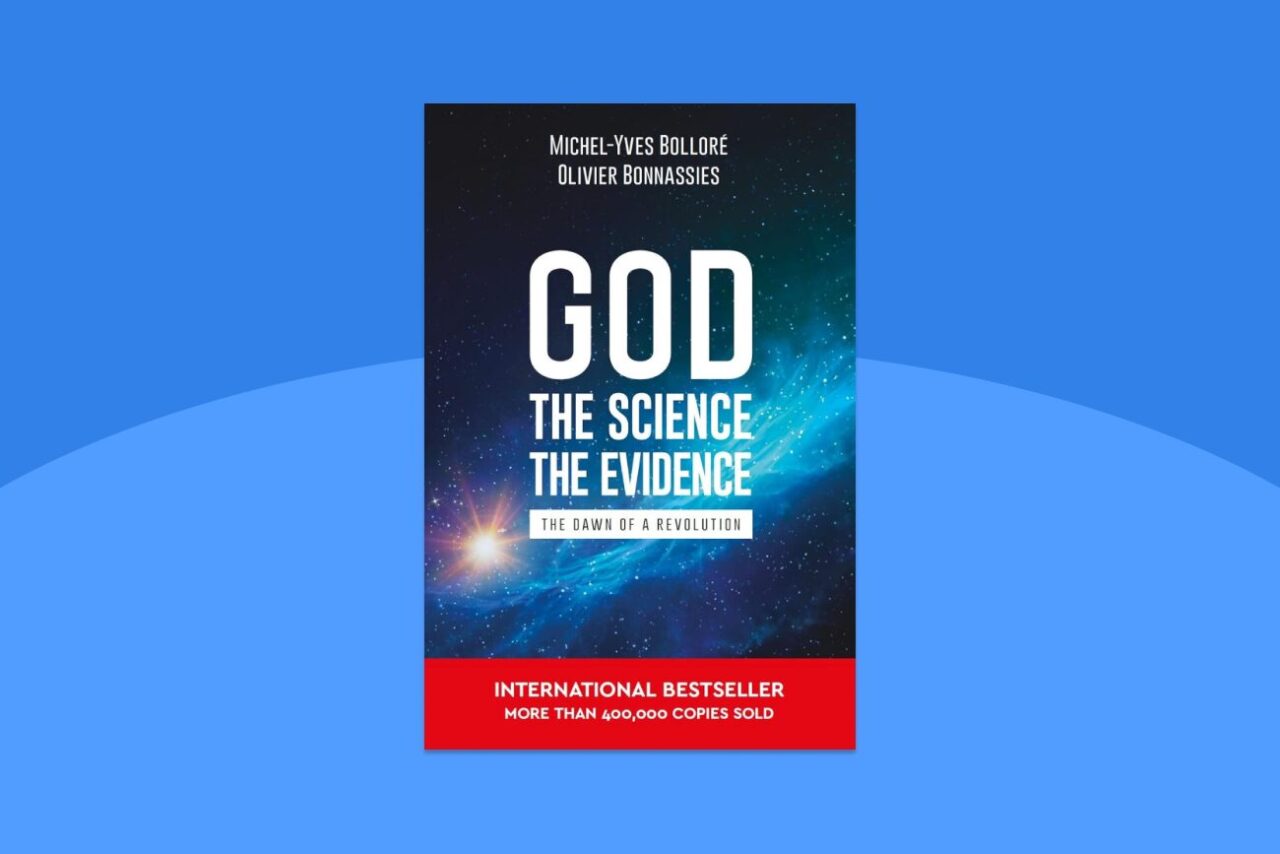
God, the Science, the Evidence: The Dawn of a Revolution
by Michel-Yves Bolloré and Olivier Bonnassies
Luxembourg: Palomar éditions, 2025; 580 pages
ISBN 9789998782402, first edition, paperback
AU$37
Michel-Yves Bolloré and Olivier Bonnassies’s God, the Science, the Evidence: The Dawn of a Revolution is a comprehensive, well-researched book that explores the evidence for a Creator God. Bolloré is the CEO of a French industrial company and a graduate of the University of Paris Dauphine where he holds a Master of Science degree and a doctorate in Business Administration. Bonnassies is an entrepreneur and is a graduate of École Polytechnique and the Institut Catholique de Paris.
The core argument of the book is that examining evidence from a range of perspectives including science, history, philosophy, and morality, suggests that it is more rational to believe in a Creator God than in materialism. While the book is generally accessible to the everyday reader, some familiarity with science is required to fully engage with the arguments as the book does cover some technical concepts such as quantum mechanics and thermodynamics.
The book is divided into two main parts. Part I argues that while for hundreds of years science supported a more materialistic, self-sufficient universe, scientific discoveries since the end of the nineteenth century put materialism into question and align better with the concept of a Creator God. It starts by discussing how the discovery of the second law of thermodynamics in 1865 challenged the prevailing idea of an eternal universe, instead suggesting the universe was expanding toward a “heat death.” It explores the Big Bang theory, developed by scientists such as Georges Lemaître and Alexander Friedmann, which proposes that time, space, and matter began from a single point, reinforcing the idea of a definitive beginning. Additionally, the book notes that the universe appears “fine-tuned”—a term originally coined by scientist Fred Hoyle in 1953—meaning that approximately twenty fundamental constants must fall within extremely narrow ranges; even minuscule variations would render the universe incapable of existing. Finally, it highlights the improbability of how non-living matter transitioned into living organisms, raising further questions about the origin of life.
Part II explores evidence for God beyond the natural sciences. It considers the person of Jesus, exploring the few plausible options of who he could have been: he never existed, was a great sage, a madman, a prophet, or the Son of God. It covers the improbable destiny of the Jewish people, the 1917 Fatima events, the question of whether humans have complete freedom to define good and evil, and the current status of philosophical proofs for God. The book concludes that reason, both scientific and non-scientific, points toward the existence of a Creator.
The book is clear, well researched, and wide-ranging, drawing on science, mathematics, philosophy, morality, and history. It includes around 100 citations from leading scientists, including Nobel laureates. While many of the ideas are not entirely original, the book’s strength lies in its comprehensive, interdisciplinary approach to supporting a single argument, which makes it distinctive. Arguments are made with supporting examples and reason, with extensive reference to a range of scientists, both Christian and non-Christian.
In addition, the book provides valuable societal context that reinforces its claims. It explains that the dominant view in the 1800s was that the universe was eternal and highlights the severe backlash faced by scientists who challenged this belief. For example, the book outlines how Alexander Friedmann’s proposal of an expanding universe was harshly opposed by the Soviet regime, leading to imprisonment, exile, and even execution of his supporters. Although repression later eased, dissenting scientists continued to be punished. Albert Einstein initially thought some of these ideas to be outrageous and publicly rebutted Friedmann but eventually changed his mind. This led him to be heavily opposed and persecuted for his “’typical Jewish’ thinking” (p. 158); he ultimately fled to the United States for safety.
The book is comprehensive in its perspectives; however, some may find the title God, the Science, the Evidence slightly misleading. While there is extensive discussion of science, about half the book focuses outside of the sciences. For some readers, a non-science focus may be of interest, but those expecting exclusive focus on the scientific evidence for God may be disappointed. In addition, while the book notes that its term “God” is “not intended to refer exclusively to the concept of God within the Abrahamic religions” (p. 24), the reality is that the book dedicates multiple chapters to Jesus and the Christian God.
While several of the arguments are logical and well argued, the framing makes some of them less convincing. Firstly, the authors make some very decisive claims about what an exclusively material universe means (for example, it could not have an absolute beginning, it cannot end in thermal death, that the laws of nature arising solely from chance and necessity have no particular reason to favour the emergence of life). While effort is made to explain these claims, materialists would deny the premise of several of these claims, undermining some of the more persuasive arguments the book provides. The authors also spend considerable effort emphasising the rationality of their arguments, such as commencing the book with endorsements from prominent scientists and making the following statement at the end of the book: “the evidence for God’s existence presented in this book is modern, clear and rational” (p. 535). A more effective approach might have been to allow readers to reach their own conclusions. Finally, in my view, it would have been beneficial to acknowledge that belief (whether towards a Creator God or materialism) does, at the end, take an element of faith (rather than purely reason).
From a personal perspective, I enjoyed this book. While I was already aware of several of the scientific arguments from Christian apologetics, having it laid out this way, together with more context from history, made it even more compelling.
Overall, the book is comprehensive, accessible, and generally convincing. I would recommend it to readers seeking a systematic guide to considering evidence towards a Creator God. It also serves as an excellent reference, offering a convenient refresher on the wide range of arguments supporting belief in a Creator.
Read more: The Easy-to-Read Book Debunking the Science & Religion Conflict Myth
More Reviews